


Equal-Area Hexagonal Grids for Global Spatial Analysis
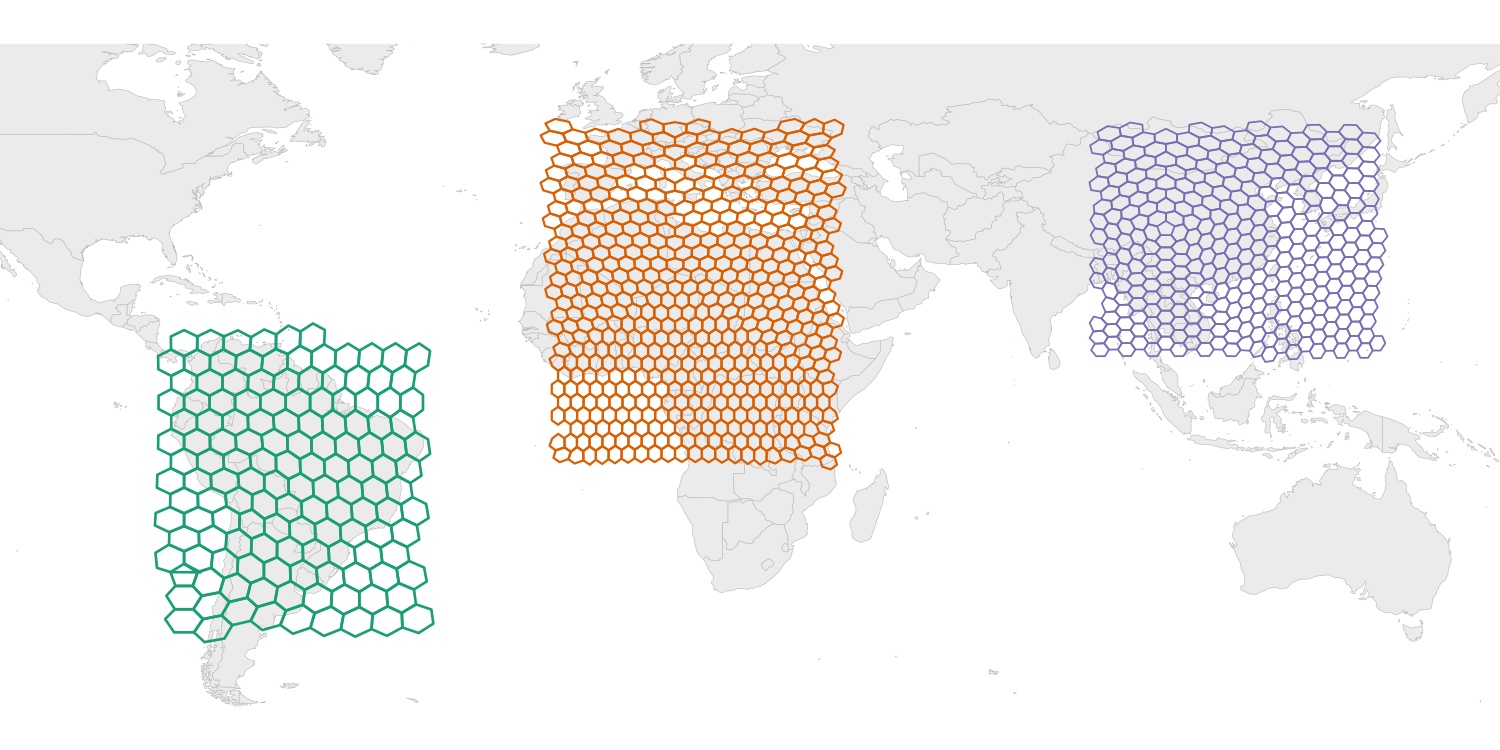
hexify assigns geographic coordinates to equal-area
hexagonal grid cells using the ISEA (Icosahedral Snyder Equal Area)
projection. Every cell has the same area regardless of latitude,
eliminating the sampling bias inherent in rectangular lat-lon grids. H3
is supported for compatibility with existing H3 workflows.
library(hexify)

cities <- data.frame(
  name = c("Vienna", "Paris", "Madrid"),
  lon = c(16.37, 2.35, -3.70),
  lat = c(48.21, 48.86, 40.42)
)

# ISEA equal-area grid (default)
grid <- hex_grid(area_km2 = 10000)
result <- hexify(cities, lon = "lon", lat = "lat", grid = grid)
plot(result)

# H3 grid (Uber's system)
h3_grid <- hex_grid(resolution = 4, type = "h3")
result_h3 <- hexify(cities, lon = "lon", lat = "lat", grid = h3_grid)
plot(result_h3)Spatial binning is fundamental to ecological modeling, epidemiology, and geographic analysis. Standard approaches using rectangular lat-lon grids introduce severe area distortions: a 1° cell at the equator covers ~12,300 km², while the same cell near the poles covers a fraction of that area. This violates the equal-sampling assumption underlying most spatial statistics.
Discrete Global Grid Systems (DGGS) solve this by partitioning Earth’s surface into cells of uniform area. hexify’s primary backend is ISEA (Icosahedral Snyder Equal Area): true equal-area hexagonal grids with apertures 3, 4 and 7 in any sequence, implemented in C++ with no external dependencies. For interoperability with industry ecosystems (FCC, Foursquare, DuckDB), hexify also supports H3 grids via a vendored C library.
Equal-area grids are directly applicable to:
Hexagons tile the sphere with three properties that squares and triangles lack:
These properties make hexagonal grids the natural choice for unbiased spatial binning. Rectangular lat-lon grids, by contrast, shrink toward the poles: a 1° cell at 60°N has half the area of the same cell at the equator.
hex_grid(): Define a grid by target
cell area (km²) or resolution levelhexify(): Assign points to grid cells
(data.frame or sf input)plot() /
hexify_heatmap(): Visualize results with base R or
ggplot2hex_grid(area_km2 = 1000, radius_km = "mars") sizes a grid
on Mars, the Moon, Titan, or any radius you give — both backendsgrid_rect(): Generate cell polygons
for a bounding boxgrid_global(): Generate a complete
global grid (all cells)grid_clip(): Clip grid to a polygon
boundary (country, region, etc.)cell_to_sf(): Convert cell IDs to sf
polygon geometriescell_to_lonlat(): Get cell center
coordinatesget_parent() /
get_children(): Navigate grid hierarchyas_dggrid() /
from_dggrid(): Convert to/from dggridR formatas_sf(): Export HexData to sf
objectas.data.frame(): Extract data with
cell assignmentshex_grid(resolution = 8, type = "h3") — vendored H3 C
library, no extra install needed# Install from CRAN
install.packages("hexify")
# Or install development version from GitHub
# install.packages("pak")
pak::pak("gcol33/hexify")library(hexify)
# Define grid: ~10,000 km² cells
grid <- hex_grid(area_km2 = 10000)
grid
#> HexGridInfo Specification
#> -------------------------
#> Aperture: 3
#> Resolution: 8
#> Area: 7773.97 km^2
#> Diagonal: 94.74 km
#> CRS: EPSG:4326
#> Total Cells: 65612
# Assign coordinates to cells
coords <- data.frame(
lon = c(-122.4, 2.35, 139.7),
lat = c(37.8, 48.9, 35.7)
)
result <- hexify(coords, lon = "lon", lat = "lat", grid = grid)
# Access cell IDs
result@cell_idlibrary(sf)
# Any CRS works - hexify transforms automatically
points_sf <- st_as_sf(coords, coords = c("lon", "lat"), crs = 4326)
result <- hexify(points_sf, area_km2 = 10000)
# Export back to sf
result_sf <- as_sf(result)# Grid for Europe
grid <- hex_grid(area_km2 = 50000)
europe_hexes <- grid_rect(c(-10, 35, 40, 70), grid)
plot(europe_hexes["cell_id"])
# Clip to a country boundary
library(rnaturalearth)
france <- ne_countries(country = "France", returnclass = "sf")
france_grid <- grid_clip(france, grid)# Species occurrence data
occurrences <- data.frame(
species = sample(c("Sp A", "Sp B", "Sp C"), 1000, replace = TRUE),
lon = runif(1000, -10, 30),
lat = runif(1000, 35, 60)
)
# Assign to grid
grid <- hex_grid(area_km2 = 20000)
occ_hex <- hexify(occurrences, lon = "lon", lat = "lat", grid = grid)
# Count per cell
occ_df <- as.data.frame(occ_hex)
occ_df$cell_id <- occ_hex@cell_id
cell_counts <- aggregate(species ~ cell_id, data = occ_df, FUN = length)
names(cell_counts)[2] <- "n_records"
# Richness per cell
richness <- aggregate(species ~ cell_id, data = occ_df,
FUN = function(x) length(unique(x)))
names(richness)[2] <- "n_species"# Quick plot
plot(result)
# Heatmap with basemap
hexify_heatmap(occ_hex, value = "n_records", basemap = TRUE)
# Custom ggplot
library(ggplot2)
cell_polys <- cell_to_sf(cell_counts$cell_id, grid)
cell_polys <- merge(cell_polys, cell_counts, by = "cell_id")
ggplot(cell_polys) +
geom_sf(aes(fill = n_records), color = "white", linewidth = 0.2) +
scale_fill_viridis_c() +
theme_minimal()is_pentagon() to
detect them.hexify_set_precision() to adjust the speed/accuracy
trade-off.“Software is like sex: it’s better when it’s free.” — Linus Torvalds
I’m a PhD student who builds R packages in my free time because I believe good tools should be free and open. I started these projects for my own work and figured others might find them useful too.
If this package saved you some time, buying me a coffee is a nice way to say thanks. It helps with my coffee addiction.
@software{hexify,
  author = {Colling, Gilles},
  title = {hexify: Equal-Area Hexagonal Grids for Spatial Analysis},
  year = {2025},
  url = {https://CRAN.R-project.org/package=hexify},
  doi = {10.32614/CRAN.package.hexify}
}MIT (see LICENSE.md)
